

What the science says about preserving a perspective
Six research foundations, drawn from seven studies, that shape what Rimembra collects, how it represents a person, and how it tests whether that representation is faithful.
Rimembra's starting question is deeply human: could the people we love continue to encounter something of our perspective after we are gone?
A meaningful answer requires more than a system that knows someone's birthday, repeats their stories or uses familiar phrases. It requires understanding how their experiences connect to their values, how they interpret a situation, and what might lead them to respond differently.
That is the ambition behind Rimembra: to make meaningful conversations possible through a faithful digital representation of who someone was. It is also a research problem. Before deciding what an AI should preserve, we need to understand what the science says about remembering, choosing and representing an individual.
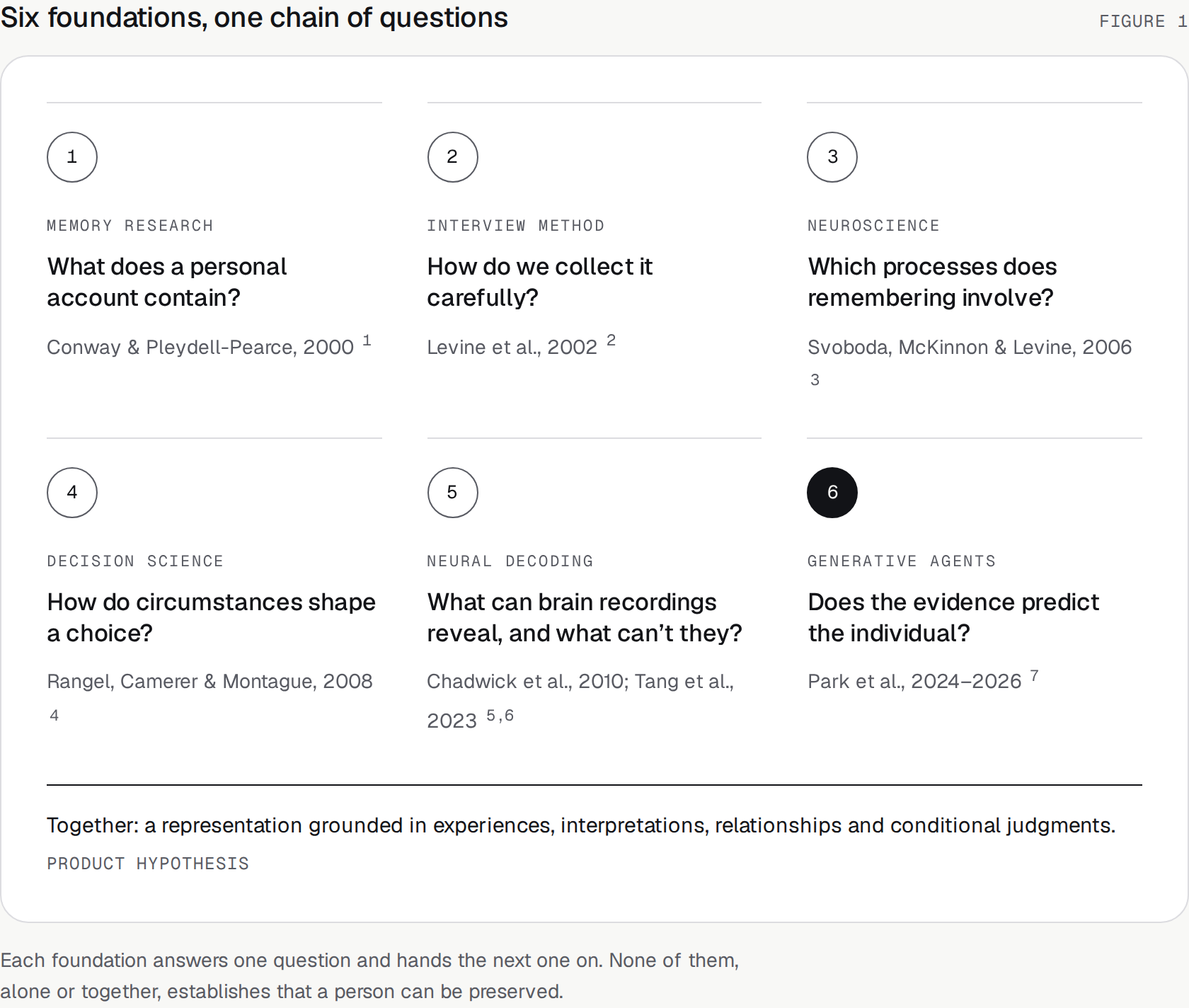
Six research foundations, drawn from seven studies, help connect those questions. They do not establish that a whole person can be captured. They provide a starting point for deciding what to collect, how to represent it, and how to test whether it is useful.
A memory includes the person doing the remembering
Imagine asking someone why they left a secure job twenty years ago. They might remember the excitement, the argument at home, or the fear of becoming someone who never took a chance. The date alone tells us very little about that perspective.
In their influential self-memory system model, Martin Conway and Christopher Pleydell-Pearce described autobiographical remembering as a construction involving personal knowledge and the current goals of the self. The relationship works in both directions: our understanding of ourselves influences remembering, while our autobiographical knowledge helps ground our goals.1
Our interpretation is that an interview should capture both an experience and its meaning to the person. What did they want then? How do they understand it now? Has that interpretation changed?
This gives us a reason to preserve attributed accounts over time, rather than silently replacing an earlier memory with a later retelling. A recollection is evidence of someone's account; it is not automatically an independently verified record of the event.
A good interview separates an episode from a general belief
Once we recognise that distinction, the next question is practical: how do we collect memories carefully?
Brian Levine and colleagues developed the Autobiographical Interview to distinguish details belonging to a specific remembered episode from semantic and other non-episodic information. Their method uses structured probing and systematic scoring. It distinguishes, for example, the details of a particular evening from general knowledge about someone's life.2
Consider the difference between "I always put family first" and "I declined a promotion because it would mean moving my children during their final school year." Both matter. The first is a self-description. The second supplies a reported decision in particular circumstances.
So we ask for concrete examples alongside broad statements, without treating either as the complete explanation of a person. An interview inspired by this distinction would still need its own validation; adopting ideas from a research instrument does not confer that instrument's validity on a new product.
Remembering involves several interacting processes
Neuroscience adds another layer. Eva Svoboda, Margaret McKinnon and Brian Levine analysed 24 functional imaging studies of autobiographical memory. Their findings described a distributed network, with contributions associated with episodic remembering, self-reflection, emotion, imagery and other processes.3
This helps explain why "mapping a memory" can mean very different things. Identifying brain systems involved in remembering is one achievement. Recovering the content of a particular experience is another.
The useful design implication is to avoid reducing a memory to a summary of what happened. A person may also describe what they pictured, how they felt, and why an experience matters. Capturing those accounts does not reproduce the underlying neural network. It creates a richer body of evidence about the person's experience.
Understanding a decision requires its circumstances
Memories help us understand a life. Future conversations also require an account of how someone approaches choices they have never discussed.
Antonio Rangel, Colin Camerer and Read Montague proposed a framework for value-based decision-making covering the representation of a problem, valuation of possible actions, action selection, evaluation of outcomes, and learning.4
That framework gives us more precise questions. What does this person notice first? What outcome matters most? Whose interests do they consider? What did the consequences teach them?
Return to the person who declined the promotion. Would their answer change if their children were older, if the move were temporary, or if the family needed the money? Varying those circumstances can help test whether "family first" explains the decision or hides important conditions.
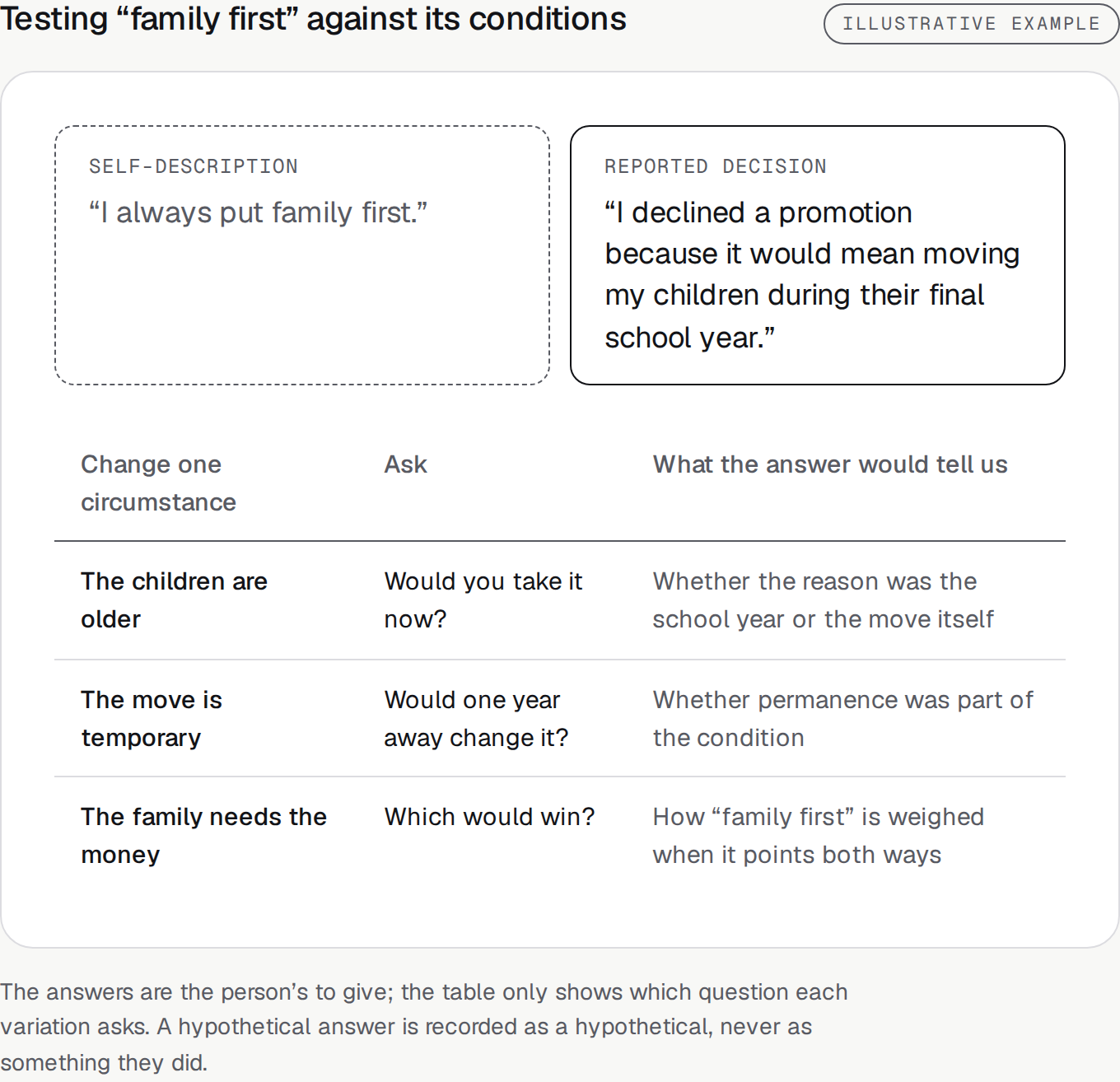
This is how we connect Your Story and How You Think: use experiences to investigate judgments, then use new scenarios to test the limits of those interpretations. A hypothetical answer remains a hypothetical answer; it does not establish how someone actually behaved.
Neural decoding shows possibility within defined limits
Two studies bring us closer to a question that attracts understandable fascination: can brain recordings reveal what someone is remembering or thinking?
Martin Chadwick and colleagues showed that fMRI activity patterns could distinguish which of three short film clips a participant was recalling. The result demonstrates information about particular memories within a controlled task. It does not demonstrate extraction of unknown life memories.5
Jerry Tang and colleagues later demonstrated semantic reconstruction of continuous language from fMRI recordings. Their decoder recovered aspects of meaning from perceived and imagined speech and silent videos. It had to be trained on many hours of each participant's own recordings, and successful decoding required that participant's cooperation.6
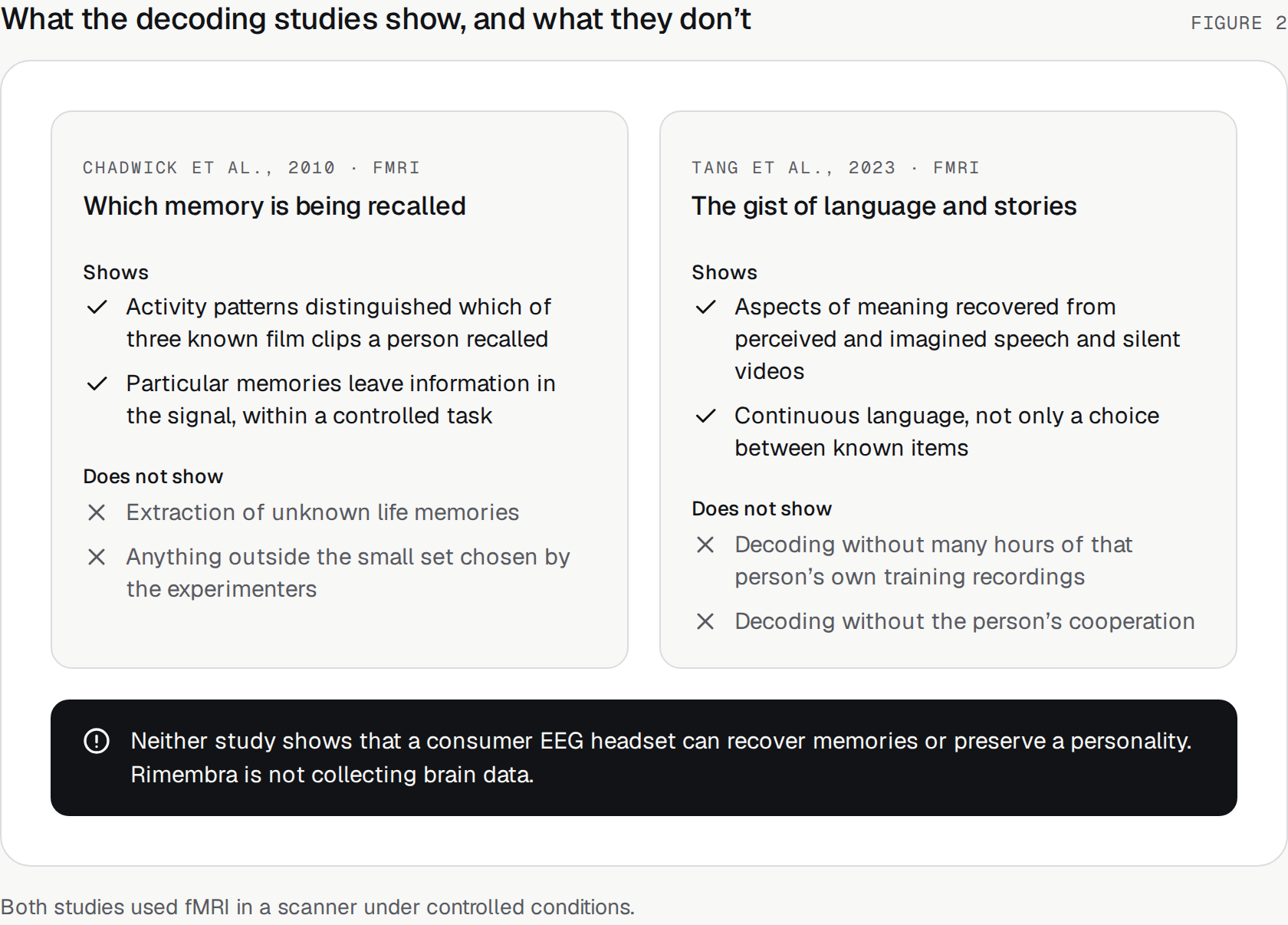
Together, these studies motivate carefully bounded research into neural information. They do not establish that a consumer EEG headset can recover memories or preserve a personality.
We are not collecting brain data. A longer-range research question is whether EEG could add useful feedback when someone reads a proposed response from their Persona. Could it help detect perceived misrepresentation beyond what we already learn from explicit ratings and behaviour? If so, could that feedback improve later responses after the headset is removed?
Those are proposed experiments, and any such study would run separately, with its own consent and its own privacy notice. Success would require showing additional predictive value, separating personal mismatch from dislike or surprise, and demonstrating improvements on unseen material. Brain activity would be another source of evidence to evaluate, not an authority that overrides the person.
Personal evidence can support simulation, but fidelity must be measured
The sixth foundation connects this research directly to AI.
Joon Sung Park and colleagues built generative agents representing 1,052 Americans using interviews, surveys or both. In the June 2026 revision of their preprint, interview-only agents achieved held-out General Social Survey accuracy equal to 83% of participants' own two-week consistency benchmark; combining interviews and surveys reached 86%.7
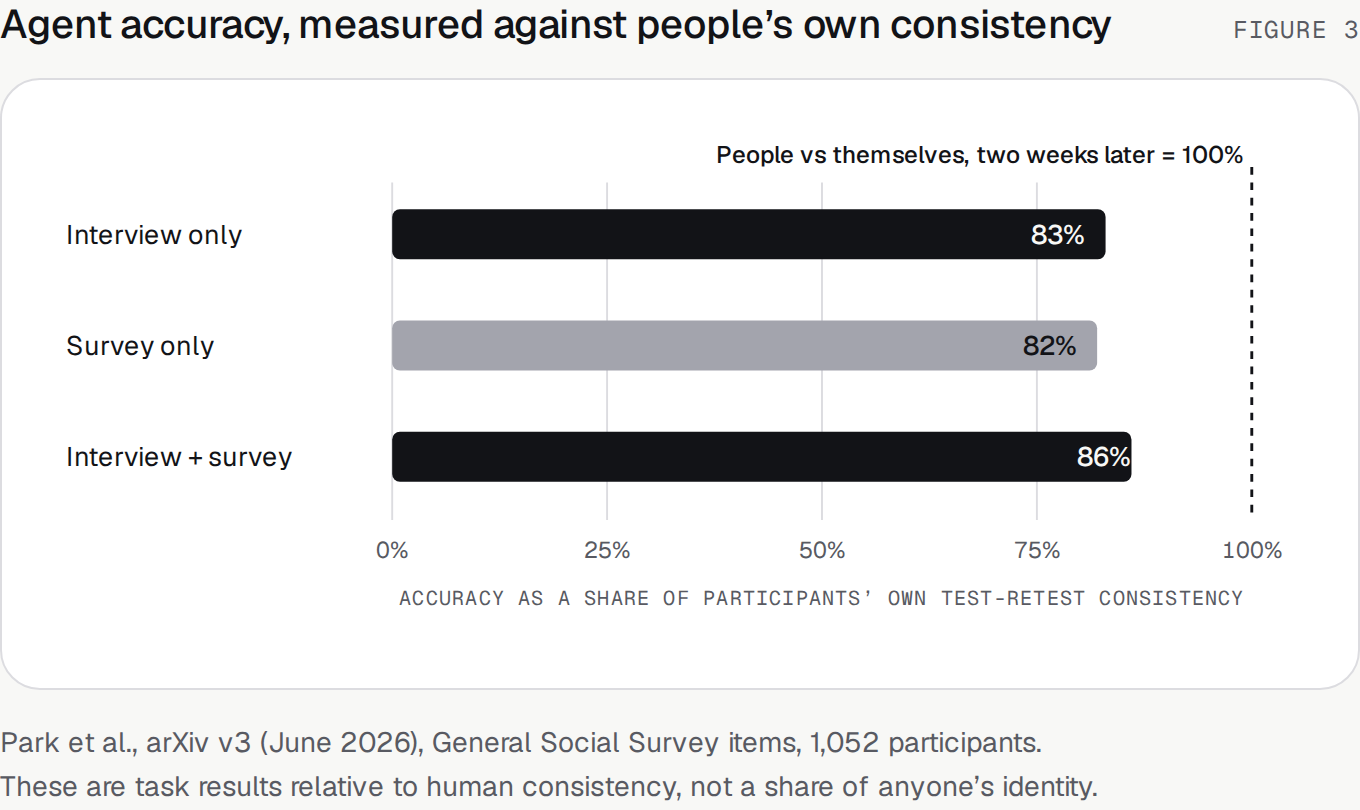
These are results relative to human test-retest consistency on a particular task. They are not percentages of a person's identity captured.
The study provides a concrete precedent for testing whether personal evidence improves individual simulation. It leaves Rimembra's central challenge open: whether a representation can remain faithful across unfamiliar conversations, relationships and time. A survey item asks for one answer. The person who declined the promotion might answer differently for a daughter than for a colleague, or differently at sixty than at forty.
Our evaluation approach therefore calls for the person and the Persona to answer unseen questions independently. The Persona must not receive the person's protected answers before responding. We then compare decisions, expressed reasons, relevant memories and uncertainty, alongside the person's own assessment. Corrections can inform a later version; fresh questions must test that version.
How these foundations shape Rimembra
The connection across these studies is a sequence of questions. Memory research asks what a personal account contains. Interview methodology asks how to collect it. Neuroscience clarifies the processes involved and the limits of decoding. Decision science asks how circumstances shape choices. Generative-agent research asks whether the collected evidence supports predictions about an individual.
Rimembra's product hypothesis brings those questions together: a representation grounded in personal experiences, interpretations, relationships and conditional judgments may support conversations that meaningfully reflect the person who supplied them.
Our proposed system follows that hypothesis through conversation, structured evidence, Persona generation, independent testing and correction. It must preserve the distinction between what someone said, what the system inferred, and what remains unknown. It must also allow for disagreement and change without turning someone into an artificially consistent character.
For the family member who someday asks a question nobody thought to record, the aspiration is a response grounded in that person's particular perspective, with honesty about the limits of what they left behind. That is the starting point we want Rimembra to build from.
The research gives us methods to borrow and claims to test. It gives us no shortcut to declaring a person preserved.
References
- Conway, M. A. and Pleydell-Pearce, C. W. (2000). The construction of autobiographical memories in the self-memory system. Psychological Review. PubMed ↩︎
- Levine, B. et al. (2002). Aging and autobiographical memory: Dissociating episodic from semantic retrieval. Psychology and Aging. PubMed ↩︎
- Svoboda, E., McKinnon, M. C. and Levine, B. (2006). The functional neuroanatomy of autobiographical memory: A meta-analysis. Neuropsychologia. PubMed ↩︎
- Rangel, A., Camerer, C. and Montague, P. R. (2008). A framework for studying the neurobiology of value-based decision making. Nature Reviews Neuroscience. PDF ↩︎
- Chadwick, M. J. et al. (2010). Decoding individual episodic memory traces in the human hippocampus. Current Biology. PubMed ↩︎
- Tang, J. et al. (2023). Semantic reconstruction of continuous language from non-invasive brain recordings. Nature Neuroscience. Nature ↩︎
- Park, J. S. et al. (2024, revised June 2026). LLM Agents Grounded in Self-Reports Enable General-Purpose Simulation of Individuals. arXiv preprint, version 3. arXiv:2411.10109 ↩︎